
INTERVIEW PREP
The Behavioral Interview Mistakes That Hide Your Best Work
Two teams were moving toward different launch dates. You caught it before the customer received two promises, got the right people talking, and worked out a safer plan. In the interview, that week becomes: “We collaborated across teams and launched on time.” Everything in that sentence is true. It also erases the judgment that made the story worth telling.
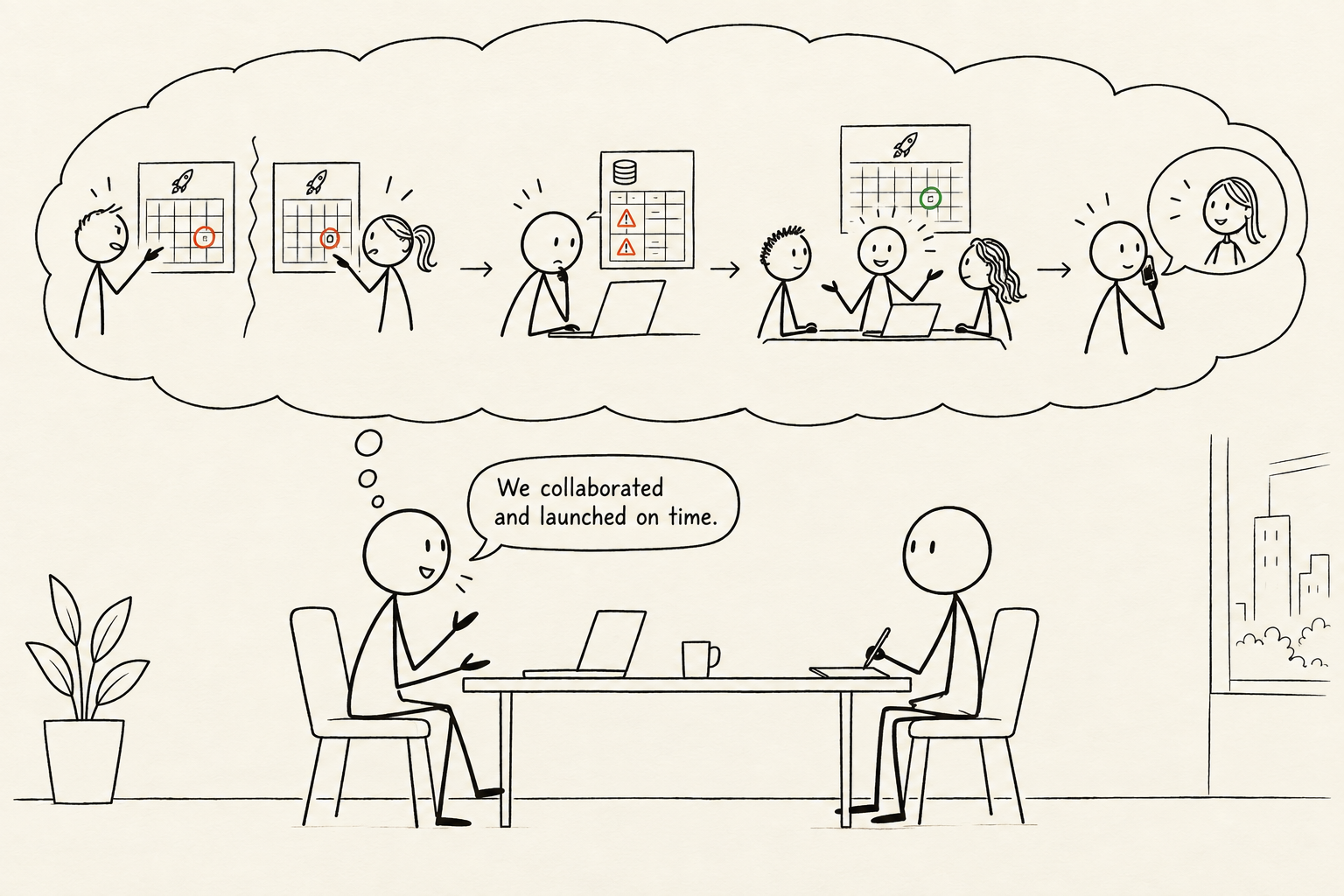
That is easy to do under interview pressure. You have to recall what happened, explain it to someone who wasn't there, and decide which details matter while you speak. An ex-Meta interviewer describes hearing a long project setup followed by “we shipped it.” The candidate's work in the middle never gets heard.
1. The story has a beginning and an end, but no middle
You explain the project for two minutes, then jump to the launch. The interviewer never hears the moment you spotted the problem or chose what to do. An interviewer on Reddit describes answers that wander before reaching the point; data-science interview replies ask for the result and its value.
It makes sense that this happens. You know the project's history, so you give background to help the listener follow. Afterward, the team remembers what shipped. The decision between those two ends is easy to leave out.
What to try: Use STAR (situation, task, action, result) as a time check. For a 90-second practice answer, spend roughly 15 seconds on what was happening and what you owned, about a minute on what you did and why, and the final 15 seconds on what changed. The timings aren't a script. Record an answer and notice when your first decision appears. If it takes a minute to get there, cut the setup until the listener can hear the judgment behind your work.
2. Your biggest story doesn't answer the question
A major launch sounds impressive. It won't answer a question about disagreement unless you can point to a real disagreement within it and say how you handled it.
Under pressure, the largest project is often the easiest one to recall. A very specific question can also make you think you need an exact match. In a software-careers discussion, a well-supported reply recommends a close, real event when the exact situation hasn't happened. An Amazon interview video warns about stretching the same example across too many questions.
What to try: Before you start, name the part of the story that answers the question. If you can't find it, choose another event. If the closest real event is slightly different, say how it connects: “I haven't had that exact situation. The closest was joining a project just before a deadline with people I hadn't worked with.” Prepare a few different events so one story doesn't have to do every job.
3. The interviewer can't tell what you personally did
“We decided to delay” leaves your role open to interpretation. Replacing every “we” with “I” creates a different problem: the answer starts to sound as if you did the team's work alone.
Most work is shared, so “we” feels both accurate and modest. A senior candidate warns that vague “we” can hide a real contribution.
What to try: Give the decision its owner and the result its team. “I checked the dependencies and recommended Tuesday. Engineering fixed the import, support updated customers, and we shipped then.” If you recommended the change but someone else approved it, say that. Listen back for each “we” attached to an action: can someone tell what your part was? When you practice in Prep, check whether the scorecard picked up your contribution. If it didn't, make that sentence clearer and try the answer again.
4. You spend the story defending yourself
“The engineer missed the deadline” tells the interviewer very little about your choices. A conflict story spent proving the other person wrong has the same problem.
Questions about mistakes and disagreements can feel personal. It's natural to explain why the problem wasn't entirely yours. An engineering interviewer asks how the candidate handled a mistake and prevented a repeat. A PM interviewer rejects a failure story that only blames a bad hire.
What to try
- For a conflict, describe the other person's concern fairly before explaining your response.
- For a mistake, say what you owned and repaired: “I promised Friday before checking the import dependency. I called the customer with a revised date and a limited workaround.” Be ready to explain what you changed afterward.
5. Your prepared story no longer fits the question
You recognize a familiar theme and begin the answer you practiced. Halfway through, it becomes clear the interviewer asked about a different part of the experience. Your answer sounds fluent but misses the question.
Knowing the wording by heart feels reassuring when you're nervous. It can also make it harder to change course or answer a follow-up. A PM interviewer describes probing why a candidate chose one path and whether they considered another.
What to try
- Keep a few cues for each story: the choice, the reason, and the outcome. Tell it aloud in fresh words.
- Practice with someone who will interrupt and ask “Why?” or “What else did you consider?” If the real question differs from the one you expected, pause and check whether your example still fits.
What did they hear?
Think back to the launch at the start. The useful work was there; the interviewer heard only a team result. After your next practice answer, ask someone: “What did you hear me do?” If they can't answer, add the missing choice, shorten whatever buried it, and tell the story once more.