
INTERVIEW PREP
Why Behavioral Interviews Feel So Hard (and How to Hate Them Less)
“Tell me about a time you handled a conflict at work.”
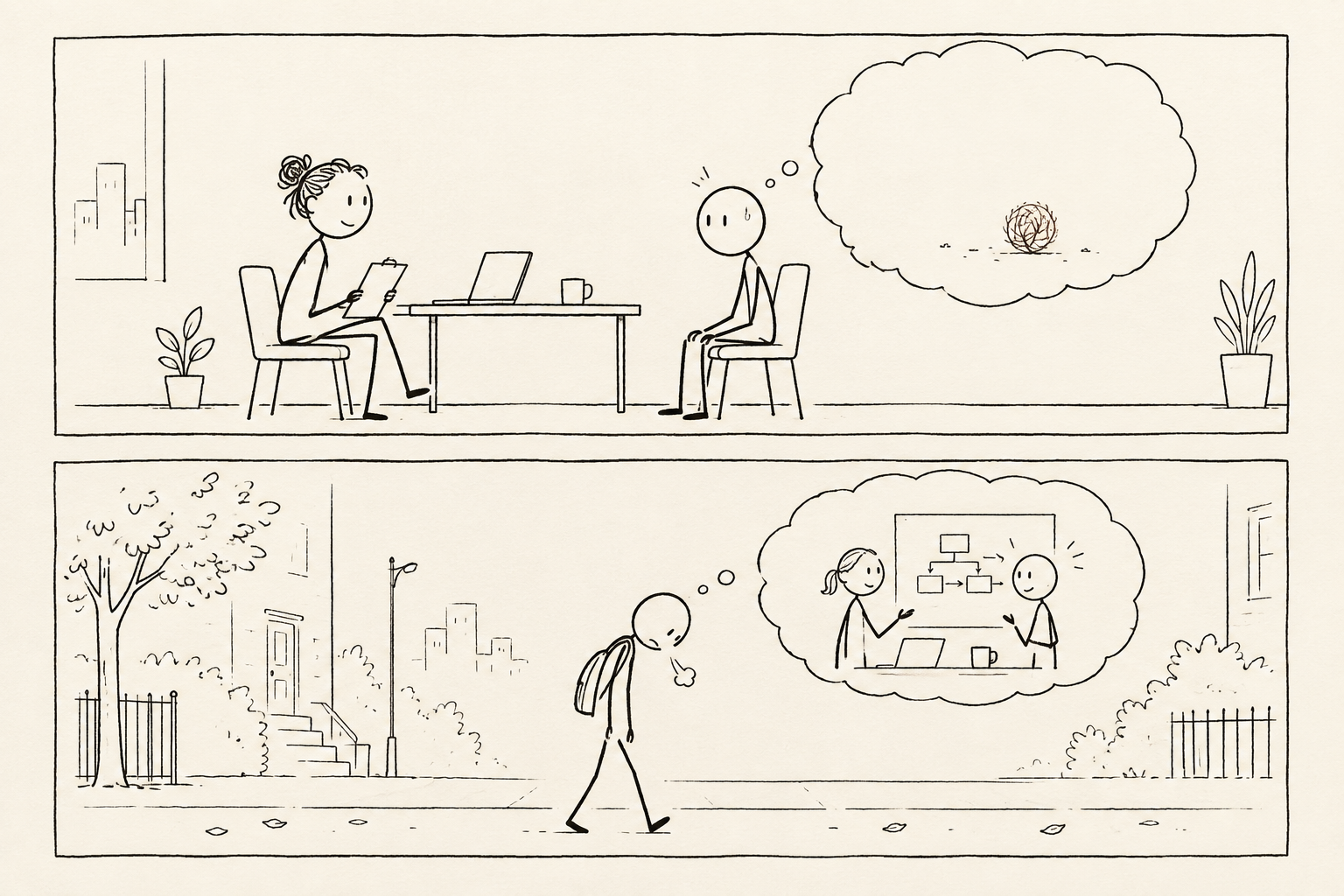
Your mind goes straight to the big, impressive answer. Nothing comes. The interviewer waits. Later, on the way home, you remember the small disagreement you handled well. You hadn't thought it counted.
That sinking “How did I have nothing to say?” feeling shows up repeatedly in the Reddit discussions and YouTube comments we reviewed. Some people remember the right example too late. Others can recall it but struggle to say it under pressure. They did the work; the interview asks them to produce a neat account of it on cue.
In those discussions, a few situations kept coming up.
1. Your work doesn't feel dramatic enough
Why this comes up: “Conflict” sounds like an argument. “Leadership” sounds like a big title. But much of the best work is quiet: you notice a risk, ask a question, or settle a disagreement before it becomes a crisis. One experienced developer said their workplace disagreements were usually ordinary conversations, leaving them without a dramatic story to tell.
What to try: Look for the decision and its stakes. Imagine you noticed two teams working toward different launch dates. You brought the owners together, found the dependency, and agreed on one date before either team promised it to a customer. That's a useful example if it really happened. The interesting part is what you noticed, why you intervened, and what changed. Nobody needed to argue.
To find your own examples, scan recent projects for three things:
- A problem you caught early.
- A decision you changed after hearing someone else's view.
- A small action that saved another person time or confusion.
Ask, “What might have happened if I hadn't stepped in?” Don't claim a disaster you can't prove. Use the answer to identify why your action mattered. A Reddit commenter says their running record of accomplishments helps them turn specific events into interview stories later.
2. The example vanishes when you're asked
Why this comes up: You have to understand the question, search your memory, and speak at the same time. A familiar experience can disappear behind unfamiliar wording. One candidate felt stuck on a question about building a relationship quickly because no exact event came to mind. A video commenter said anxiety made the speaking part harder even when they could think of answers.
What to try: Write down four or five real situations and tag each with the skills it could show: collaboration, judgment, ownership, or learning. One Reddit commenter organizes examples this way. A delayed project, for instance, might answer a question about a mistake or a difficult decision; you would emphasize different details for each.
Practice the part where you choose the story. Have someone ask you an unfamiliar question. Take a few seconds, pick an event from your index, and start. An interviewer said they would rather wait through a short pause than hear an answer that starts immediately and wanders.
If there is no exact match, name the closest one honestly. A well-supported Reddit reply suggests using an unexpected deadline with unfamiliar colleagues to answer a question about building a working relationship quickly. You might begin: “I haven't had that exact situation. The closest was joining a project just before a deadline with people I hadn't worked with before.” Then explain how it connects to what was asked.
3. A polished story can feel fake
Why this comes up: Sample answers often make one person the hero of a tidy project. Real work has shared credit and mixed results. A YouTube commenter puts the fear bluntly: hiring seems to favor whoever tells the best, possibly made-up story over someone who knows the work and does it well.
What to try: Prepare the version you can defend in follow-ups. For a mistake, write down your choice, how you repaired it, and what you changed afterward. An engineering interviewer asks for exactly those details; a PM interviewer pushes back on stories that blame someone else.
Suppose you coordinate a release and promise a customer a Friday date. On Wednesday, an engineer finds that a data import needs more work. An answer could sound like this:
“I promised Friday before checking the import dependency with engineering. When we found the blocker, I called the customer, explained the delay, and offered a limited workaround for Friday. The full release went out the following Tuesday. The customer was disappointed, and I should have checked earlier. I now confirm those dependencies before committing to a date.”
This still leaves room for hard follow-ups. Why did you promise Friday? Why wasn't the import checked? Did the workaround help? Prepare to discuss those details, including what others did and what remained unresolved. You don't need to manufacture a happy ending. One Amazon-video commenter even reports passing after saying they had no example for some questions. That's one person's experience, not a promise.
4. You don't know what the interviewer is listening for
Why this comes up: A tough question rarely tells you how the answer will be judged. One developer described getting through technical rounds, then being rejected twice with vague feedback about values and communication. In a PM hiring discussion, a commenter worried that decisions can come down to presentation nitpicks. If the criteria are hidden, it's hard to know what evidence an answer needs.
What to try: Ask what the question is likely testing. A conflict question may be about how you worked through disagreement. A failure question may be about ownership and what changed afterward. Those are educated guesses; each role and interviewer can differ. If the wording is broad, you can clarify: “Would an example about a teammate disagreement be useful here?”
For each answer, check whether you've given the interviewer something they can judge. In a conflict story, can they tell what the other person wanted, what you did, and how the decision was made? In a failure story, can they tell what you owned and what changed? These details make your answer easier to assess even when the rubric is hidden. Prep lets you practice role-specific questions aloud and respond to follow-ups. Its scorecard shows an overall score and the signals your answer demonstrated, so you can see which parts need more evidence before trying again.
Keep practicing between interviews
One Reddit commenter practices by speaking answers into their phone and reviewing the response. Another said their first few interviews were tense, but they grew more relaxed with repetition. A YouTube viewer also found mock interviews and repeated interviews useful.
After a practice session or an interview, write down one question that stalled you and any follow-up you struggled to answer. Try it again aloud. If you couldn't find an example, add a cue to your story notes. If your part in the story got lost, say your decision sooner. Then test that change with a different question. Preparation becomes more useful when each round gives you one specific thing to work on before the next.